HugeGraph-LLM Workflow
This page explains the processing flow in the HugeGraph-LLM Web UI. See HugeGraph-LLM for startup instructions.
0. Configuration Panel
Above the tabs sits a collapsible configuration panel with five sections: 1. Set up the HugeGraph server., 2. Set up the LLM., 3. Set up the Embedding., 4. Set up the Reranker., and 5. Set up the vector engine.. Each section has its own apply button, and applying a change writes the supported fields back to .env. The header also shows the current prompt language.
1. Build RAG Indexes
The first tab splits documents into a chunk vector index. It also extracts vertices and edges according to a schema, writes them to HugeGraph, and maintains a vertex vector index.
Input comes from either the text sub-tab or the file sub-tab. Uploads accept .txt, .docx, and .pdf, and several files can be selected at once.
Common operations are Import into Vector, Extract Graph Data (1), Load into GraphDB (2), and Update Vid Embedding. Load into GraphDB (2) also refreshes the vertex vector index, so the separate Update Vid Embedding step is only needed when the graph already held data. The Graph Extraction Split Type dropdown next to these buttons chooses document, paragraph, or sentence. document keeps the whole input as one unit; the other two split long documents before extraction.
The page can also inspect or clear chunk indexes, vertex indexes, and graph data. Clearing removes existing data, so first confirm that the current graph and indexes are not still used by other queries.
Two collapsed helpers sit below the main controls:
Graph Schema Generatortakes query examples and a few-shot example and produces a schema for the Graph Schema field.Graph Extraction Prompt Generatortakes an expected scenario, such as social relationships or a financial knowledge graph, and a selected reference example, and produces a Graph Extract Prompt Header.
2. GraphRAG Queries
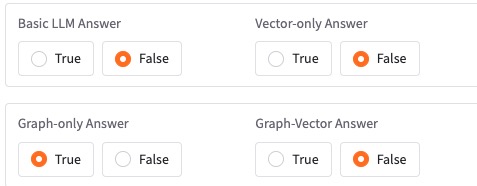
The second tab can answer directly with the LLM, use only chunk-vector retrieval, use only graph retrieval, or combine graph and vector retrieval.
Graph retrieval first matches HugeGraph vertices exactly by keyword and then uses vector similarity if no exact match exists. The matched vertices are passed to Text2Gremlin. If generation or execution fails, the pipeline can fall back to a predefined traversal.
Template Num controls how Text2Gremlin participates in graph retrieval:
- A negative value skips Text2Gremlin entirely, so graph retrieval goes straight to the predefined traversal.
0generates Gremlin without any examples (zero-shot).- A positive value retrieves that many similar examples from the example index and uses the template-guided result. The example count is clamped to the range 0 to 10.
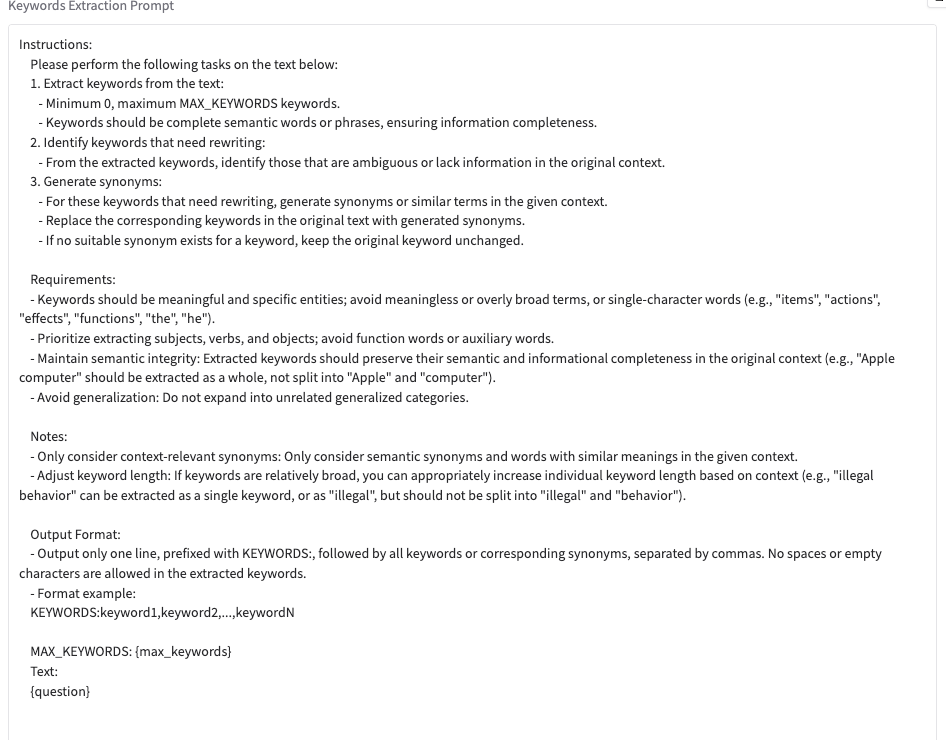
Other controls on this tab are Rerank method (bleu or reranker), Graph Ratio, Near neighbor first, and Query related information, plus editable Query Prompt and Keywords Extraction Prompt fields.
Below the single-question panel is a batch back-testing panel. Upload an .xlsx or .csv file of questions, set Max Lines To Show, and click Generate Answer (Batch). The answers appear in a preview table and can be downloaded as a file. A template file is offered next to the upload control.
3. Text2Gremlin
The third tab has two parts. The upper part builds the example vector index from a .json or .csv file of question and Gremlin pairs; the bundled resources/demo/text2gremlin.csv is used when no file is uploaded.
The lower part reads the graph schema, retrieves similar natural-language and Gremlin examples, fills the prompt with the question, schema, examples, and matched vertices, then generates Gremlin and optionally executes it. Number of refer examples sets how many examples are retrieved, from 0 to 10, and defaults to 2. The results appear in four fields: Gremlin with a template, Gremlin without a template, and the execution output for each.
A custom prompt must contain {query}, {schema}, {example}, and {vertices}. The REST API rejects a request if any placeholder is missing.
4. Graph and Administration Tools
Graph Tools runs a Gremlin query directly against the configured graph, triggers a manual graph backup, and can initialize demo data in HugeGraph through a beta action. A background job also backs up the graph every day at 01:00, and a second background task keeps vertex-id embeddings up to date while the process runs.
Admin Tools is password protected. Entering the configured ADMIN_TOKEN reveals the tail of logs/llm-server.log, which refreshes every 60 seconds, along with buttons to refresh or clear it. Access is refused while ADMIN_TOKEN is empty or still set to the placeholder xxxx.
When ENABLE_LOGIN=True, the Web UI asks for basic credentials with the fixed user name rag and USER_TOKEN as the password, and the REST API requires USER_TOKEN as a Bearer token. The log endpoint additionally requires a separately configured, secure ADMIN_TOKEN.
In production, enable HugeGraph-LLM login, replace USER_TOKEN and ADMIN_TOKEN, and enforce a source IP allowlist at the firewall or network entry point. Separately enable Server authentication and authorization, retain Server audit logs (normally audit-*.log), and grant GRAPH_USER minimum required permissions. AI service tokens do not replace Server authentication.
5. Prompt Language
Set LANGUAGE=EN or LANGUAGE=CN in hugegraph-llm/.env, then restart the service. This selects the language of built-in prompts; it does not translate input documents and is not a field in the /rag request body.
6. REST Calls
The Web UI and REST API use the same pipeline. For application integration, use /rag, /rag/graph, /graph/extract, and /text2gremlin; see the REST API for request formats.