# HugeGraph-Loader Quick Start
LLMS index: [llms.txt](/llms.txt)
---
### 1 HugeGraph-Loader Overview
HugeGraph-Loader is the data import component of HugeGraph, which can convert data from various data sources into graph vertices and edges and import them into the graph database in batches.
Currently supported data sources include:
- Local disk file or directory, supports TEXT, CSV and JSON format files, supports compressed files
- HDFS file or directory supports compressed files
- Mainstream relational databases, such as MySQL, PostgreSQL, Oracle, SQL Server
- Kafka topic
- An existing HugeGraph graph, used to copy data from one graph into another
Local disk files and HDFS files support resumable uploads.
It will be explained in detail below.
> Note: HugeGraph-Loader requires HugeGraph Server service, please refer to [HugeGraph-Server Quick Start](/docs/quickstart/hugegraph/hugegraph-server) to download and start Server
> **Testing Guide**: For running HugeGraph-Loader tests locally, please refer to [HugeGraph Toolchain Local Testing Guide](/docs/guides/toolchain-local-test)
### 2 Get HugeGraph-Loader
HugeGraph-Loader is available in the following three ways:
- Use docker image (Convenient for Test/Dev)
- Download the compiled tarball
- Clone source code then compile and install
#### 2.1 Use Docker image (Convenient for Test/Dev)
We can deploy the loader service using `docker run -itd --name loader hugegraph/loader:1.7.0`. For the data that needs to be loaded, it can be copied into the loader container either by mounting `-v /path/to/data/file:/loader/file` or by using `docker cp`.
Alternatively, to start the loader using docker-compose, the command is `docker-compose up -d`. An example of the docker-compose.yml is as follows:
```yaml
version: '3'
services:
server:
image: hugegraph/hugegraph:1.7.0
container_name: server
ports:
- 8080:8080
hubble:
image: hugegraph/hubble:1.7.0
container_name: hubble
ports:
- 8088:8088
loader:
image: hugegraph/loader:1.7.0
container_name: loader
# mount your own data here
# volumes:
# - /path/to/data/file:/loader/file
```
The specific data loading process can be referenced under [4.5 User Docker to load data](#45-use-docker-to-load-data)
> Note:
> 1. The docker image of hugegraph-loader is a convenience release to start hugegraph-loader quickly, but not **official distribution** artifacts. You can find more details from [ASF Release Distribution Policy](https://infra.apache.org/release-distribution.html#dockerhub).
>
> 2. Recommend to use `release tag`(like `1.7.0`) for the stable version. Use `latest` tag to experience the newest functions in development.
#### 2.2 Download the compiled archive
Download the latest version of the HugeGraph-Toolchain release package:
```bash
export VERSION=1.7.0
export ARCHIVE="apache-hugegraph-toolchain-incubating-${VERSION}"
wget "https://downloads.apache.org/hugegraph/${VERSION}/${ARCHIVE}.tar.gz"
tar zxf "${ARCHIVE}.tar.gz"
```
#### 2.3 Clone source code to compile and install
Clone the latest version of HugeGraph-Loader source package:
```bash
# 1. get from github
git clone https://github.com/apache/hugegraph-toolchain.git
# 2. Download a released source package
export VERSION=1.7.0
export ARCHIVE="apache-hugegraph-toolchain-incubating-${VERSION}"
wget "https://downloads.apache.org/hugegraph/${VERSION}/${ARCHIVE}-src.tar.gz"
```
> [!DETAILS]- How to install OJDBC
> Due to the license limitation of the `Oracle OJDBC`, you need to manually install ojdbc to the local maven repository.
> Visit the [Oracle jdbc downloads](https://www.oracle.com/database/technologies/appdev/jdbc-drivers-archive.html) page. Select Oracle Database 12c Release 2 (12.2.0.1) drivers, as shown in the following figure.
>
> After opening the link, select "ojdbc8.jar".
>
> Install ojdbc8 to the local maven repository, enter the directory where `ojdbc8.jar` is located, and execute the following command.
> ```
> mvn install:install-file -Dfile=./ojdbc8.jar -DgroupId=com.oracle -DartifactId=ojdbc8 -Dversion=12.2.0.1 -Dpackaging=jar
> ```
Compile and generate tar package:
```bash
cd hugegraph-toolchain
mvn clean package -pl hugegraph-loader -am -DskipTests -ntp
```
### 3 How to use
The basic process of using HugeGraph-Loader is divided into the following steps:
- Write graph schema
- Prepare data files
- Write input source map files
- Execute command import
#### 3.1 Construct graph schema
This step is the modeling process. Users need to have a clear idea of their existing data and the graph model they want to create, and then write the schema to build the graph model.
For example, if you want to create a graph with two types of vertices and two types of edges, the vertices are "people" and "software", the edges are "people know people" and "people create software", and these vertices and edges have some attributes, For example, the vertex "person" has: "name", "age" and other attributes,
"Software" includes: "name", "sale price" and other attributes; side "knowledge" includes: "date" attribute and so on.
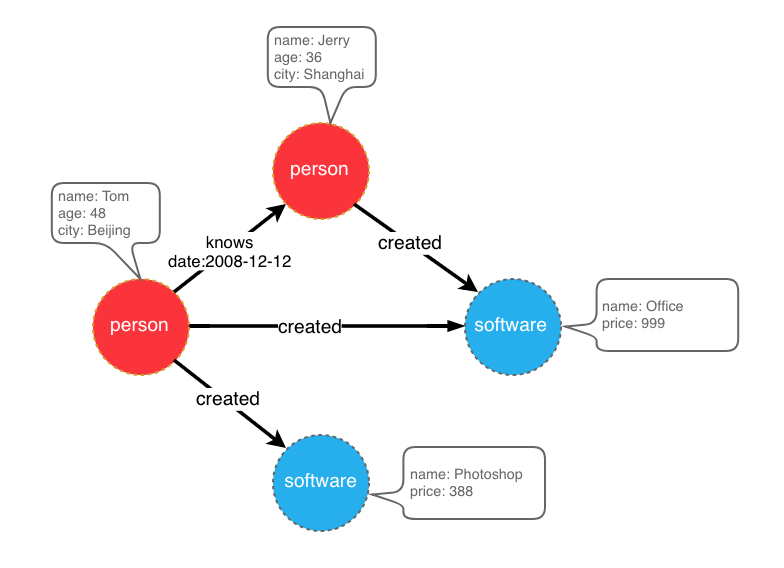
graph model example
After designing the graph model, we can use `groovy` to write the definition of `schema` and save it to a file, here named `schema.groovy`.
```groovy
// Create some properties
schema.propertyKey("name").asText().ifNotExist().create();
schema.propertyKey("age").asInt().ifNotExist().create();
schema.propertyKey("city").asText().ifNotExist().create();
schema.propertyKey("date").asText().ifNotExist().create();
schema.propertyKey("price").asDouble().ifNotExist().create();
// Create the person vertex type, which has three attributes: name, age, city, and the primary key is name
schema.vertexLabel("person").properties("name", "age", "city").primaryKeys("name").ifNotExist().create();
// Create a software vertex type, which has two properties: name, price, the primary key is name
schema.vertexLabel("software").properties("name", "price").primaryKeys("name").ifNotExist().create();
// Create the knows edge type, which goes from person to person
schema.edgeLabel("knows").sourceLabel("person").targetLabel("person").ifNotExist().create();
// Create the created edge type, which points from person to software
schema.edgeLabel("created").sourceLabel("person").targetLabel("software").ifNotExist().create();
```
> Please refer to the corresponding section in [hugegraph-client](/docs/clients/hugegraph-client) for the detailed description of the schema.
#### 3.2 Prepare data
The data sources currently supported by HugeGraph-Loader include:
- local disk file or directory
- HDFS file or directory
- Partial relational database
- Kafka topic
- An existing HugeGraph graph
##### 3.2.1 Data source structure
###### 3.2.1.1 Local disk file or directory
The user can specify a local disk file as the data source. If the data is scattered in multiple files, a certain directory is also supported as the data source, but multiple directories are not supported as the data source for the time being.
For example, my data is scattered in multiple files, part-0, part-1 ... part-n. To perform the import, it must be ensured that they are placed in one directory. Then in the loader's mapping file, specify `path` as the directory.
Supported file formats include:
- TEXT
- CSV
- JSON
TEXT is a text file with custom delimiters, the first line is usually the header, and the name of each column is recorded, and no header line is allowed (specified in the mapping file). Each remaining row represents a record, which will be converted into a vertex/edge; each column of the row corresponds to a field, which will be converted into the id, label or attribute of the vertex/edge;
An example is as follows:
```
id|name|lang|price|ISBN
1|lop|java|328|ISBN978-7-107-18618-5
2|ripple|java|199|ISBN978-7-100-13678-5
```
CSV is a TEXT file with commas `,` as delimiters. When a column value itself contains a comma, the column value needs to be enclosed in double quotes, for example:
```
marko,29,Beijing
"li,nary",26,"Wu,han"
```
The JSON file requires that each line is a JSON string, and the format of each line needs to be consistent.
```json
{"source_name": "marko", "target_name": "vadas", "date": "20160110", "weight": 0.5}
{"source_name": "marko", "target_name": "josh", "date": "20130220", "weight": 1.0}
```
###### 3.2.1.2 HDFS file or directory
Users can also specify HDFS files or directories as data sources, all of the above requirements for `local disk files or directories` apply here. In addition, since HDFS usually stores compressed files, loader also provides support for compressed files, and `local disk file or directory` also supports compressed files.
Currently supported compressed file types include: GZIP, BZ2, XZ, LZMA, SNAPPY_RAW, SNAPPY_FRAMED, Z, DEFLATE, LZ4_BLOCK, LZ4_FRAMED, ORC, and PARQUET.
###### 3.2.1.3 Mainstream relational database
The loader also supports some relational databases as data sources, and currently supports MySQL, PostgreSQL, Oracle, and SQL Server.
However, the requirements for the table structure are relatively strict at present. If **association query** needs to be done during the import process, such a table structure is not allowed. The associated query means: after reading a row of the table, it is found that the value of a certain column cannot be used directly (such as a foreign key), and you need to do another query to determine the true value of the column.
For example, Suppose there are three tables, person, software and created
```
// person schema
id | name | age | city
```
```
// software schema
id | name | lang | price
```
```
// created schema
id | p_id | s_id | date
```
If the id strategy of person or software is specified as PRIMARY_KEY when modeling (schema), choose name as the primary key (note: this is the concept of vertex-label in hugegraph), when importing edge data, the source vertex and target need to be spliced out. For the id of the vertex, you must go to the person/software table with p_id/s_id to find the corresponding name. In the case of the schema that requires additional query, the loader does not support it temporarily. In this case, the following two methods can be used instead:
1. The id strategy of person and software is still specified as PRIMARY_KEY, but the id column of the person table and software table is used as the primary key attribute of the vertex, so that the id can be generated by directly splicing p_id and s_id with the label of the vertex when importing an edge;
2. Specify the id policy of person and software as CUSTOMIZE, and then directly use the id column of the person table and the software table as the vertex id, so that p_id and s_id can be used directly when importing edges;
The key point is to make the edge use p_id and s_id directly, don't check it again.
##### 3.2.2 Prepare vertex and edge data
###### 3.2.2.1 Vertex Data
The vertex data file consists of data line by line. Generally, each line is used as a vertex, and each column is used as a vertex attribute. The following description uses CSV format as an example.
- person vertex data (the data itself does not contain a header)
```csv
Tom,48,Beijing
Jerry,36,Shanghai
```
- software vertex data (the data itself contains the header)
```csv
name,price
Photoshop,999
Office,388
```
###### 3.2.2.2 Edge data
The edge data file consists of data line by line. Generally, each line is used as an edge. Some columns are used as the IDs of the source and target vertices, and other columns are used as edge attributes. The following uses JSON format as an example.
- knows edge data
```json
{"source_name": "Tom", "target_name": "Jerry", "date": "2008-12-12"}
```
- created edge data
```json
{"source_name": "Tom", "target_name": "Photoshop"}
{"source_name": "Tom", "target_name": "Office"}
{"source_name": "Jerry", "target_name": "Office"}
```
#### 3.3 Write data source mapping file
##### 3.3.1 Mapping file overview
The mapping file of the input source is used to describe how to establish the mapping relationship between the input source data and the vertex type/edge type of the graph. It is organized in `JSON` format and consists of multiple mapping blocks, each of which is responsible for mapping an input source. Mapped to vertices and edges.
Specifically, each mapping block contains **an input source** and multiple **vertex mapping** and **edge mapping** blocks, and the input source block corresponds to the `local disk file or directory`, ` HDFS file or directory` and `relational database` are responsible for describing the basic information of the data source, such as where the data is, what format, what is the delimiter, etc. The vertex map/edge map is bound to the input source, which columns of the input source can be selected, which columns are used as ids, which columns are used as attributes, and what attributes are mapped to each column, the values of the columns are mapped to what values of attributes, and so on.
In the simplest terms, each mapping block describes: where is the file to be imported, which type of vertices/edges each line of the file is to be used as which columns of the file need to be imported, and the corresponding vertices/edges of these columns. what properties, etc.
> Note: The format of the mapping file before version 0.11.0 and the format after 0.11.0 has changed greatly. For the convenience of expression, the mapping file (format) before 0.11.0 is called version 1.0, and the version after 0.11.0 is version 2.0. And unless otherwise specified, the "map file" refers to version 2.0.
> [!DETAILS]- Click to expand/collapse the skeleton of the map file for version 2.0
> ```json
> {
> "version": "2.0",
> "structs": [
> {
> "id": "1",
> "input": {
> },
> "vertices": [
> {},
> {}
> ],
> "edges": [
> {},
> {}
> ]
> }
> ]
> }
> ```
Two versions of the mapping file are given directly here (the above graph model and data file are described)
> [!DETAILS]- Click to expand/collapse the mapping file for version 2.0
> ```json
> {
> "version": "2.0",
> "structs": [
> {
> "id": "1",
> "skip": false,
> "input": {
> "type": "FILE",
> "path": "vertex_person.csv",
> "file_filter": {
> "extensions": [
> "*"
> ]
> },
> "format": "CSV",
> "delimiter": ",",
> "date_format": "yyyy-MM-dd HH:mm:ss",
> "time_zone": "GMT+8",
> "skipped_line": {
> "regex": "(^#|^//).*|"
> },
> "compression": "NONE",
> "header": [
> "name",
> "age",
> "city"
> ],
> "charset": "UTF-8",
> "list_format": {
> "start_symbol": "[",
> "elem_delimiter": "|",
> "end_symbol": "]"
> }
> },
> "vertices": [
> {
> "label": "person",
> "skip": false,
> "id": null,
> "unfold": false,
> "field_mapping": {},
> "value_mapping": {},
> "selected": [],
> "ignored": [],
> "null_values": [
> ""
> ],
> "update_strategies": {}
> }
> ],
> "edges": []
> },
> {
> "id": "2",
> "skip": false,
> "input": {
> "type": "FILE",
> "path": "vertex_software.csv",
> "file_filter": {
> "extensions": [
> "*"
> ]
> },
> "format": "CSV",
> "delimiter": ",",
> "date_format": "yyyy-MM-dd HH:mm:ss",
> "time_zone": "GMT+8",
> "skipped_line": {
> "regex": "(^#|^//).*|"
> },
> "compression": "NONE",
> "header": null,
> "charset": "UTF-8",
> "list_format": {
> "start_symbol": "",
> "elem_delimiter": ",",
> "end_symbol": ""
> }
> },
> "vertices": [
> {
> "label": "software",
> "skip": false,
> "id": null,
> "unfold": false,
> "field_mapping": {},
> "value_mapping": {},
> "selected": [],
> "ignored": [],
> "null_values": [
> ""
> ],
> "update_strategies": {}
> }
> ],
> "edges": []
> },
> {
> "id": "3",
> "skip": false,
> "input": {
> "type": "FILE",
> "path": "edge_knows.json",
> "file_filter": {
> "extensions": [
> "*"
> ]
> },
> "format": "JSON",
> "delimiter": null,
> "date_format": "yyyy-MM-dd HH:mm:ss",
> "time_zone": "GMT+8",
> "skipped_line": {
> "regex": "(^#|^//).*|"
> },
> "compression": "NONE",
> "header": null,
> "charset": "UTF-8",
> "list_format": null
> },
> "vertices": [],
> "edges": [
> {
> "label": "knows",
> "skip": false,
> "source": [
> "source_name"
> ],
> "unfold_source": false,
> "target": [
> "target_name"
> ],
> "unfold_target": false,
> "field_mapping": {
> "source_name": "name",
> "target_name": "name"
> },
> "value_mapping": {},
> "selected": [],
> "ignored": [],
> "null_values": [
> ""
> ],
> "update_strategies": {}
> }
> ]
> },
> {
> "id": "4",
> "skip": false,
> "input": {
> "type": "FILE",
> "path": "edge_created.json",
> "file_filter": {
> "extensions": [
> "*"
> ]
> },
> "format": "JSON",
> "delimiter": null,
> "date_format": "yyyy-MM-dd HH:mm:ss",
> "time_zone": "GMT+8",
> "skipped_line": {
> "regex": "(^#|^//).*|"
> },
> "compression": "NONE",
> "header": null,
> "charset": "UTF-8",
> "list_format": null
> },
> "vertices": [],
> "edges": [
> {
> "label": "created",
> "skip": false,
> "source": [
> "source_name"
> ],
> "unfold_source": false,
> "target": [
> "target_name"
> ],
> "unfold_target": false,
> "field_mapping": {
> "source_name": "name",
> "target_name": "name"
> },
> "value_mapping": {},
> "selected": [],
> "ignored": [],
> "null_values": [
> ""
> ],
> "update_strategies": {}
> }
> ]
> }
> ]
> }
> ```
> [!DETAILS]- Click to expand/collapse the mapping file for version 1.0
> ```json
> {
> "vertices": [
> {
> "label": "person",
> "input": {
> "type": "file",
> "path": "vertex_person.csv",
> "format": "CSV",
> "header": ["name", "age", "city"],
> "charset": "UTF-8"
> }
> },
> {
> "label": "software",
> "input": {
> "type": "file",
> "path": "vertex_software.csv",
> "format": "CSV"
> }
> }
> ],
> "edges": [
> {
> "label": "knows",
> "source": ["source_name"],
> "target": ["target_name"],
> "input": {
> "type": "file",
> "path": "edge_knows.json",
> "format": "JSON"
> },
> "field_mapping": {
> "source_name": "name",
> "target_name": "name"
> }
> },
> {
> "label": "created",
> "source": ["source_name"],
> "target": ["target_name"],
> "input": {
> "type": "file",
> "path": "edge_created.json",
> "format": "JSON"
> },
> "field_mapping": {
> "source_name": "name",
> "target_name": "name"
> }
> }
> ]
> }
> ```
The 1.0 version of the mapping file is centered on the vertex and edge, and sets the input source; while the 2.0 version is centered on the input source, and sets the vertex and edge mapping. Some input sources (such as a file) can generate both vertices and edges. If you write in the 1.0 format, you need to write an input block in each of the vertex and edge mapping blocks. The two input blocks are exactly the same; and the 2.0 version only needs to write input once. Therefore, compared with version 1.0, version 2.0 can save some repetitive writing of input.
In the bin directory of hugegraph-loader-{version}, there is a script tool `mapping-convert.sh` that can directly convert the mapping file of version 1.0 to version 2.0. The usage is as follows:
```bash
bin/mapping-convert.sh struct.json
```
A struct-v2.json will be generated in the same directory as struct.json.
The bin directory also ships `utf8-bom-to-utf8.sh`, which strips the UTF-8 BOM from a single data file, or from every file under a directory. It is useful when a CSV or TEXT file exported by a Windows tool fails to parse because its first header column carries an invisible BOM:
```bash
bin/utf8-bom-to-utf8.sh /path/to/file-or-dir
```
##### 3.3.2 Input Source
Input sources are currently divided into five categories: FILE, HDFS, JDBC, KAFKA and GRAPH, which are distinguished by the `type` node. We call them local file input sources, HDFS input sources, JDBC input sources, KAFKA input sources and GRAPH input source, which are described below.
###### 3.3.2.1 Local file input source
- id: The id of the input source. This field is used to support some internal functions. It is not required (it will be automatically generated if it is not filled in). It is strongly recommended to write it, which is very helpful for debugging;
- skip: whether to skip the input source, because the JSON file cannot add comments, if you do not want to import an input source during a certain import, but do not want to delete the configuration of the input source, you can set it to true to skip it, the default is false, not required;
- input: input source map block, composite structure
- type: an input source type, file or FILE must be filled;
- path: the path of the local file or directory, the absolute path or the relative path relative to the mapping file, it is recommended to use the absolute path, required;
- file_filter: filter files with compound conditions from `path`, compound structure, currently only supports configuration extensions, represented by child node `extensions`, the default is "*", which means to keep all files;
- format: the format of the local file, the optional values are CSV, TEXT and JSON, which must be uppercase, the default is CSV, optional;
- header: the column name of each column of the file, if not specified, the first line of the data file will be used as the header; when the file itself has a header and the header is specified, the first line of the file will be treated as a normal data line; JSON The file does not need to specify a header, optional;
- has_header: for CSV and TEXT, the first line of every file is dropped when it is identical to the header, so a header repeated in each part file of a directory is not imported as data. Set this to `false` to turn that check off when the first line of a file is real data that happens to equal the header, optional;
- delimiter: The column delimiter of the file line. The default depends on `format`: a comma `","` for CSV and a tab `"\t"` for TEXT; a CSV file accepts no other delimiter. The `JSON` file does not need to be specified, optional;
- charset: the encoded character set of the file, the default is `UTF-8`, optional;
- date_format: custom date format, the default value is yyyy-MM-dd HH:mm:ss, optional; if the date is presented in the form of a timestamp, this item must be written as `timestamp` (fixed writing);
- extra_date_formats: a list of fallback date formats, tried when a value does not match `date_format`, empty by default, optional;
- time_zone: Set which time zone the date data is in, the default value is `GMT+8`, optional;
- skipped_line: The line to be skipped, compound structure, currently only the regular expression of the line to be skipped can be configured, described by the child node `regex`. The default regex is `(^#|^//).*|`, which skips lines starting with `#` or `//` and empty lines; to keep such lines, set `regex` to a pattern that matches nothing, optional;
- compression: The compression format of the file, the optional values are NONE, GZIP, BZ2, XZ, LZMA, SNAPPY_RAW, SNAPPY_FRAMED, Z, DEFLATE, LZ4_BLOCK, LZ4_FRAMED, ORC and PARQUET, the default is NONE, which means a non-compressed file, optional; for ORC and PARQUET the header is matched case-insensitively;
- list_format: When a column of the file (non-JSON) is a collection structure (the Cardinality of the PropertyKey in the corresponding figure is Set or List), you can use this item to set the start character, separator, and end character of the column, compound structure :
- start_symbol: The start character of the collection structure column (the default value is the empty string `""`, JSON format currently does not support specification)
- elem_delimiter: the delimiter of the collection structure column (the default value is `|`, and it must differ from `delimiter`; JSON format currently only supports native `,` delimiter)
- end_symbol: the end character of the collection structure column (the default value is the empty string `""`, the JSON format does not currently support specification)
- ignored_elems: the elements dropped after the column is split, the default value is `[""]`, so empty elements are ignored
###### 3.3.2.2 HDFS input source
The nodes and meanings of the above `local file input source` are basically applicable here. Only the different and unique nodes of the HDFS input source are listed below.
- type: input source type, must fill in hdfs or HDFS, required;
- path: the path of the HDFS file or directory, it must be the absolute path of HDFS, required;
- core_site_path: the path of the core-site.xml file of the HDFS cluster, the key point is to specify the address of the NameNode (`fs.default.name`) and the implementation of the file system (`fs.hdfs.impl`), required;
- hdfs_site_path: the path of the hdfs-site.xml file of the HDFS cluster, optional;
- dir_filter: when `path` is a directory, decides which sub-directories are walked into, compound structure, optional:
- include_regex: only directories whose name matches this regular expression are read, empty by default, which places no restriction;
- exclude_regex: directories whose name matches this regular expression are skipped, empty by default;
- kerberos_config: how to authenticate against a Kerberos-secured HDFS cluster, compound structure, optional:
- enable: whether to authenticate with Kerberos, the default is false;
- krb5_conf: the path of the krb5.conf file, required when `enable` is true;
- principal: the Kerberos principal, required when `enable` is true;
- keytab: the path of the keytab file, required when `enable` is true;
###### 3.3.2.3 JDBC input source
As mentioned above, it supports multiple relational databases, but because their mapping structures are very similar, they are collectively referred to as JDBC input sources, and then use the `vendor` node to distinguish different databases.
- type: input source type, must fill in jdbc or JDBC, required;
- vendor: database type, optional options are [MySQL, PostgreSQL, Oracle, SQLServer], case-insensitive, required;
- driver: the JDBC driver class, optional; when it is left out, the default driver of the `vendor` listed in the tables below is used;
- url: the url of the database that jdbc wants to connect to, required;
- database: the name of the database to be connected, required;
- schema: The name of the schema to be connected, different databases have different requirements, and the details are explained below;
- table: the name of the table to be connected, at least one of `table` or `custom_sql` is required;
- custom_sql: custom SQL statement, at least one of `table` or `custom_sql` is required;
- username: username to connect to the database, required;
- password: password for connecting to the database, required;
- where: an extra condition appended to the generated `select` statement, written without the `where` keyword, optional;
- batch_size: The size of one page when obtaining table data by page, the default is 500, optional;
**MYSQL**
| Node | Fixed value or common value |
|--------|-----------------------------|
| vendor | MYSQL |
| driver | com.mysql.cj.jdbc.Driver |
| url | jdbc:mysql://127.0.0.1:3306 |
schema: nullable, if filled in, it must be the same as the value of database
**POSTGRESQL**
| Node | Fixed value or common value |
|--------|----------------------------------|
| vendor | POSTGRESQL |
| driver | org.postgresql.Driver |
| url | jdbc:postgresql://127.0.0.1:5432 |
schema: nullable, default is "public"
**ORACLE**
| Node | Fixed value or common value |
|--------|----------------------------------|
| vendor | ORACLE |
| driver | oracle.jdbc.driver.OracleDriver |
| url | jdbc:oracle:thin:@127.0.0.1:1521 |
schema: nullable, the default value is the username in upper case
**SQLSERVER**
| Node | Fixed value or common value |
|--------|----------------------------------------------|
| vendor | SQLSERVER |
| driver | com.microsoft.sqlserver.jdbc.SQLServerDriver |
| url | jdbc:sqlserver://127.0.0.1:1433 |
schema: required
###### 3.3.2.4 Kafka input source
- type: input source type, `kafka` or `KAFKA`, required;
- bootstrap_server: the list of kafka bootstrap servers, required;
- topic: the topic to subscribe to, required;
- group: group of Kafka consumers, required;
- from_beginning: whether to start from the earliest offset of the topic (`auto.offset.reset=earliest`) instead of the latest one, default is false, optional;
- format: format of each message, options are CSV, TEXT and JSON, must be uppercase, required;
- header: column name of each column of a message; no header line is read from the topic, so it has to be given for CSV and TEXT, while JSON messages do not need it;
- delimiter: delimiter of the message columns, used by TEXT only, since CSV always splits on `,`, optional;
- charset: encoding charset of the messages, default is UTF-8, optional;
- date_format: customized date format, default value is yyyy-MM-dd HH:mm:ss, optional; if the date is presented in the form of timestamp, this item must be written as timestamp (fixed);
- extra_date_formats: a customized list of another date formats, empty by default, optional; each item in the list is an alternate date format to the date_format specified date format;
- time_zone: set which time zone the date data is in, default is GMT+8, optional;
- skipped_line: the line you want to skip, composite structure, currently can only configure the regular expression of the line to be skipped, described by the child node regex, the default is not to skip any line, optional;
- batch_size: the maximum number of records fetched in one poll (`max.poll.records`), default is 500, optional;
- early_stop: the record pulled from Kafka broker at a certain time is empty, stop the task, default is false, only for debugging, optional;
###### 3.3.2.5 GRAPH input Source
The GRAPH input source reads vertices and edges out of another HugeGraph graph, reached through HugeGraph-PD, and writes them into the target graph. When a mapping file contains a GRAPH input source, every input source in it that is not skipped has to be a GRAPH input source as well, and the loader puts the target graph into `RESTORING` mode for the duration of the import.
- type: Data source type; must be filled in as `graph` or `GRAPH` (required);
- graphspace: Source graphSpace name (required);
- graph: Source graph name (required);
- username: HugeGraph username; the `--username` command-line option is used when this is empty;
- password: HugeGraph password; the `--password` command-line option is used when this is empty;
- selected_vertices: the vertex labels to copy, each item written as `{"label": "...", "properties": [...], "query": {...}}`, where `properties` narrows the copied properties and `query` is an optional filter passed to the source graph;
- ignored_vertices: the vertex labels to skip, each item written as `{"label": "...", "properties": [...]}`;
- selected_edges: the edge labels to copy, items have the same shape as in `selected_vertices`;
- ignored_edges: the edge labels to skip, items have the same shape as in `ignored_vertices`;
- pd-peers: HugeGraph-PD node addresses of the source cluster; the `--pd-peers` option is used when this is empty;
- meta-endpoints: Meta service endpoints of the source cluster; the `--meta-endpoints` option is used when this is empty;
- cluster: Source cluster name; the `--cluster` option is used when this is empty;
- batch_size: Batch size for reading data from the source graph; default is 500;
##### 3.3.3 Vertex and Edge Mapping
The nodes of vertex and edge mapping (a key in the JSON file) have a lot of the same parts. The same parts are introduced first, and then the unique nodes of `vertex map` and `edge map` are introduced respectively.
**Nodes of the same section**
- label: `label` to which the vertex/edge data to be imported belongs, required;
- skip: whether to skip this vertex/edge mapping while the input source and the other mappings stay active, the default is false, optional;
- field_mapping: Map the column name of the input source column to the attribute name of the vertex/edge, optional;
- value_mapping: map the data value of the input source to the attribute value of the vertex/edge, optional;
- selected: select some columns to insert, other unselected ones are not inserted, cannot exist at the same time as `ignored`, optional;
- ignored: ignore some columns so that they do not participate in insertion, cannot exist at the same time as `selected`, optional;
- null_values: You can specify some strings to represent null values, such as "NULL". If the vertex/edge attribute corresponding to this column is also a nullable attribute, the value of this attribute will not be set when constructing the vertex/edge, optional ;
- update_strategies: If the data needs to be **updated** in batches in a specific way, you can specify a specific update strategy for each attribute (see below for details), optional;
- unfold: Whether to unfold the column, each unfolded column will form a row with other columns, which is equivalent to unfolding into multiple rows; for example, the value of a certain column (id column) of the file is `[1,2,3]`, The values of other columns are `18,Beijing`. When unfold is set, this row will become 3 rows, namely: `1,18,Beijing`, `2,18,Beijing` and `3,18, Beijing`. Note that this will only expand the column selected as id. Default false, optional;
**Update strategy** supports 8 types: (requires all uppercase)
1. Value accumulation: `SUM`
2. Take the greater of the two numbers/dates: `BIGGER`
3. Take the smaller of two numbers/dates: `SMALLER`
4. **Set** property takes union: `UNION`
5. **Set** attribute intersection: `INTERSECTION`
6. **List** attribute append element: `APPEND`
7. **List/Set** attribute delete element: `ELIMINATE`
8. Override an existing property: `OVERRIDE`
**Note:** If the newly imported attribute value is empty, the existing old data will be used instead of the empty value. For the effect, please refer to the following example
```json
// The update strategy is specified in the JSON file as follows
{
"vertices": [
{
"label": "person",
"update_strategies": {
"age": "SMALLER",
"set": "UNION"
},
"input": {
"type": "file",
"path": "vertex_person.txt",
"format": "TEXT",
"header": ["name", "age", "set"]
}
}
]
}
// 1. Write a line of data with the OVERRIDE update strategy (null means empty here)
'a b null null'
// 2. Write another line
'null null c d'
// 3. Finally we can get
'a b c d'
// If there is no update strategy, you will get
'null null c d'
```
> **Note** : After adopting the batch update strategy, the number of disk read requests will increase significantly, and the import speed will be several times slower than that of pure write coverage (at this time HDD disk [IOPS](https://en.wikipedia .org/wiki/IOPS) will be the bottleneck, SSD is recommended for speed)
**Unique Nodes for Vertex Maps**
- id: Specify a column as the id column of the vertex. When the vertex id policy is `CUSTOMIZE`, it is required; when the id policy is `PRIMARY_KEY`, it must be empty;
**Unique Nodes for Edge Maps**
- source: Select certain columns of the input source as the id column of **source vertex**. When the id policy of the source vertex is `CUSTOMIZE`, a certain column must be specified as the id column of the vertex; when the id policy of the source vertex is ` When PRIMARY_KEY`, one or more columns must be specified for splicing the id of the generated vertex, that is, no matter which id strategy is used, this item is required;
- target: Specify certain columns as the id columns of **target vertex**, similar to source, so I won't repeat them;
- unfold_source: Whether to unfold the source column of the file, the effect is similar to that in the vertex map, and will not be repeated;
- unfold_target: Whether to unfold the target column of the file, the effect is similar to that in the vertex mapping, and will not be repeated;
#### 3.4 Execute command import
After preparing the graph model, data file, and input source mapping relationship file, the data file can be imported into the graph database.
The import process is controlled by commands submitted by the user, and the user can control the specific process of execution through different parameters.
##### 3.4.1 Parameter description
| Parameter | Default value | Required or not | Description |
|------------------------------------------|---------------|-----------------|-------------------------------------------------------------------------------------------------------------------------------------------------------------------------------------------|
| `-f` or `--file` | | Y | Path to configure script |
| `-g` or `--graph` | hugegraph | | Graph name |
| `--graphspace` | DEFAULT | | Graph space name |
| `-s` or `--schema` | | | Schema file path; optional when the Schema already exists |
| `-h` or `--host` or `-i` | localhost | | Address of HugeGraphServer |
| `-p` or `--port` | 8080 | | Port number of HugeGraphServer |
| `--username` | null | | When HugeGraphServer enables permission authentication, the username of the current graph |
| `--password` | null | | When HugeGraphServer enables permission authentication, the password of the current graph |
| `--create-graph` | false | | Whether to automatically create the graph if it does not exist |
| `--token` | null | | When HugeGraphServer has enabled authorization authentication, the token of the current graph |
| `--protocol` | http | | Protocol for sending requests to the server, optional http or https |
| `--pd-peers` | | | PD service node addresses |
| `--pd-token` | | | Token for accessing PD service |
| `--meta-endpoints` | | | Meta information storage service addresses |
| `--direct` | false | | Whether to directly connect to HugeGraph-Store |
| `--route-type` | NODE_PORT | | Route selection method (optional values: NODE_PORT / DDS / BOTH) |
| `--cluster` | hg | | Cluster name |
| `--trust-store-file` | | | When the request protocol is https, the client's certificate file path |
| `--trust-store-password` | | | When the request protocol is https, the client certificate password |
| `--clear-all-data` | false | | Whether to clear the original data on the server before importing data |
| `--clear-timeout` | 240 | | Timeout for clearing the original data on the server before importing data |
| `--incremental-mode` | false | | Whether to use the breakpoint resume mode; only input sources FILE and HDFS support this mode. Enabling this mode allows starting the import from where the last import stopped |
| `--failure-mode` | false | | When failure mode is true, previously failed data will be imported. Generally, the failed data file needs to be manually corrected and edited before re-importing |
| `--batch-insert-threads` | CPUs | | Batch insert thread pool size (CPUs is the number of **logical cores** available to the current OS) |
| `--single-insert-threads` | 8 | | Size of single insert thread pool |
| `--max-conn` | 4 * CPUs | | The maximum number of HTTP connections between HugeClient and HugeGraphServer; while it is left at its default, it is raised automatically to 4 * `--batch-insert-threads` |
| `--max-conn-per-route` | 2 * CPUs | | The maximum number of HTTP connections for each route between HugeClient and HugeGraphServer; while it is left at its default, it is raised automatically to 2 * `--batch-insert-threads` |
| `--batch-size` | 500 | | The number of data items in each batch when importing data |
| `--max-parse-errors` | 1 | | The maximum number of data parsing errors allowed (per line); the program exits when this value is reached |
| `--max-insert-errors` | 500 | | The maximum number of data insertion errors allowed (per row); the program exits when this value is reached |
| `--timeout` | 60 | | Timeout (seconds) for insert result return |
| `--shutdown-timeout` | 10 | | Waiting time for multithreading to stop (seconds) |
| `--retry-times` | 3 | | Maximum number of retries after a timeout |
| `--retry-interval` | 10 | | Interval before retry (seconds) |
| `--check-vertex` | false | | Whether to check if the vertices connected by the edge exist when inserting the edge |
| `--print-progress` | true | | Whether to print the number of imported items in real time on the console |
| `--dry-run` | false | | Enable this mode to only parse data without importing; usually used for testing |
| `--help` or `-help` | false | | Print help information |
| `--parser-threads` or `--parallel-count` | max(2,CPUs/2) | | Number of parallel read pipelines; `--parallel-count` is deprecated |
| `--start-file` | 0 | | Start file index for partial loading |
| `--end-file` | -1 | | End file index for partial loading |
| `--scatter-sources` | false | | Scatter multiple sources for I/O optimization |
| `--cdc-flush-interval` | 30000 | | The flush interval for Flink CDC |
| `--cdc-sink-parallelism` | 1 | | The sink parallelism for Flink CDC |
| `--max-read-errors` | 1 | | The maximum number of read error lines before exiting |
| `--max-read-lines` | -1L | | The maximum number of read lines, task stops when reached |
| `--test-mode` | false | | Whether the loader works in test mode |
| `--use-prefilter` | false | | Whether to filter vertex in advance |
| `--short-id` | | | Map a customized vertex ID to a shorter generated ID, written as `label:field:type`, where `type` is one of boolean, byte, int, long, float, double, text, blob, date and uuid; repeat the option to cover several labels |
| `--vertex-edge-limit` | -1L | | The maximum number of vertex's edges |
| `--sink-type` | true | | `spark-loader` only: true writes through the HugeGraph server API, false generates HFiles and bulk-loads them into HBase |
| `--vertex-partitions` | 64 | | The number of partitions of the HBase vertex table, used with `--sink-type false` |
| `--edge-partitions` | 64 | | The number of partitions of the HBase edge table, used with `--sink-type false` |
| `--vertex-table-name` | | | HBase vertex table name, used with `--sink-type false` |
| `--edge-table-name` | | | HBase edge table name, used with `--sink-type false` |
| `--hbase-zk-quorum` | | | HBase ZooKeeper quorum, used with `--sink-type false` |
| `--hbase-zk-port` | | | HBase ZooKeeper port, used with `--sink-type false` |
| `--hbase-zk-parent` | | | HBase ZooKeeper parent, used with `--sink-type false` |
| `--restore` | false | | Set graph mode to RESTORING |
| `--backend` | hstore | | The backend store type when creating graph if not exists |
| `--serializer` | binary | | The serializer type when creating graph if not exists |
| `--scheduler-type` | distributed | | The task scheduler type when creating graph if not exists |
| `--batch-failure-fallback` | true | | Whether to fallback to single insert when batch insert fails |
> The loader prints its usage and exits when it is given fewer than three arguments, so `-f struct.json` on its own is not enough.
##### 3.4.2 Breakpoint Continuation Mode
Usually, the Loader task takes a long time to execute. If the import interrupt process exits for some reason, and next time you want to continue the import from the interrupted point, this is the scenario of using breakpoint continuation.
The user sets the command line parameter --incremental-mode to true to open the breakpoint resume mode. The key to breakpoint continuation lies in the progress file. When the import process exits, the import progress at the time of exit will be recorded.
Recorded in the progress file, the progress file is located in the `${struct}` directory, the file name is like `load-progress_${timestamp}`, ${struct} is the prefix of the mapping file, and ${timestamp} is the start of the import
moment, formatted as `yyyyMMdd-HHmmss`. For example, for an import task started at `2019-10-10 12:30:30`, the mapping file used is `struct-example.json`, then the path of the progress file is the same as struct-example.json
Sibling `struct-example/load-progress_20191010-123030`. When the directory holds several progress files, the resumed import reads the last one in name order, which is the most recent one.
> Note: The generation of progress files is independent of whether --incremental-mode is turned on or not, and a progress file is generated at the end of each import.
If the data file formats are all legal and the import task is stopped by the user (CTRL + C or kill, kill -9 is not supported), that is to say, if there is no error record, the next import only needs to be set to
Continue for the breakpoint.
But if the limit of --max-read-errors, --max-parse-errors or --max-insert-errors is reached because too much data is invalid or network abnormality is reached, Loader will record these original rows that failed into
the failure file, after the user modifies the data lines in the failure file, set --failure-mode to true to import these "failure files" as input sources (does not affect the normal file import),
Of course, if there is still a problem with the modified data line, it will be logged again to the failure file (don't worry about duplicate lines, they are dropped when the file is closed). Failure mode lifts the three error limits above, so the whole failure file is scanned.
Each input source, that is each item of `structs` in the mapping file, gets its own failure file. The file is named after the `id` of that input source with the suffix `.error` and is stored in the `${struct}/failure-data` directory.
Every failed line is written as a pair of lines: a tip line starting with `#### READ ERROR:`, `#### PARSE ERROR:` or `#### INSERT ERROR:`, followed by the original data line. When the input source has a header, that header is written as JSON to a sibling `${id}.header` file, so the failure file can be read back with the right columns.
For example, if the mapping file has an input source with id `1` holding a vertex mapping person and an input source with id `3` holding an edge mapping knows, each of which has some error lines, you will see the following files in the `${struct}/failure-data` directory when the Loader exits:
- 1.error: the failed lines of input source 1, each preceded by its tip line
- 1.header: the header of input source 1, written only when that input source has a header
- 3.error: the failed lines of input source 3
- 3.header: the header of input source 3
> A `.error` file that turns out to be empty is deleted when the Loader exits, so only the input sources that really had failed lines leave a file behind. In incremental mode new failures are appended to the existing file, otherwise the file is rewritten from scratch.
##### 3.4.3 logs directory file description
The log and error data during program execution will be written into the hugegraph-loader.log file.
##### 3.4.4 Execute command
Run bin/hugegraph-loader.sh and pass in parameters
```bash
bin/hugegraph-loader.sh -g {GRAPH_NAME} -f ${INPUT_DESC_FILE} -s ${SCHEMA_FILE} -h {HOST} -p {PORT}
```
The script runs the JVM under `JAVA_HOME` when that variable is set, and `java` from the `PATH` otherwise. It passes the contents of the `JVM_OPTS` environment variable, then `-Xmx10g` and the class path built from `lib/`, to that JVM, so `JVM_OPTS` is the place to add JVM flags. Logging is configured by `conf/log4j2.xml`.
### 4 Complete example
Given below is an example in the example directory of the hugegraph-loader package. ([GitHub address](https://github.com/apache/hugegraph-toolchain/tree/master/hugegraph-loader/assembly/static/example/file))
#### 4.1 Prepare data
Vertex file: `example/file/vertex_person.csv`
```csv
marko,29,Beijing
vadas,27,Hongkong
josh,32,Beijing
peter,35,Shanghai
"li,nary",26,"Wu,han"
tom,null,NULL
```
Vertex file: `example/file/vertex_software.txt`
```text
id|name|lang|price|ISBN
1|lop|java|328|ISBN978-7-107-18618-5
2|ripple|java|199|ISBN978-7-100-13678-5
```
Edge file: `example/file/edge_knows.json`
```json
{"source_name": "marko", "target_name": "vadas", "date": "20160110", "weight": 0.5}
{"source_name": "marko", "target_name": "josh", "date": "20130220", "weight": 1.0}
```
Edge file: `example/file/edge_created.json`
```json
{"aname": "marko", "bname": "lop", "date": "20171210", "weight": 0.4}
{"aname": "josh", "bname": "lop", "date": "20091111", "weight": 0.4}
{"aname": "josh", "bname": "ripple", "date": "20171210", "weight": 1.0}
{"aname": "peter", "bname": "lop", "date": "20170324", "weight": 0.2}
```
#### 4.2 Write schema
> [!DETAILS]- Click to expand/collapse the schema file: example/file/schema.groovy
> ```groovy
> schema.propertyKey("name").asText().ifNotExist().create();
> schema.propertyKey("age").asInt().ifNotExist().create();
> schema.propertyKey("city").asText().ifNotExist().create();
> schema.propertyKey("weight").asDouble().ifNotExist().create();
> schema.propertyKey("lang").asText().ifNotExist().create();
> schema.propertyKey("date").asText().ifNotExist().create();
> schema.propertyKey("price").asDouble().ifNotExist().create();
>
> schema.vertexLabel("person").properties("name", "age", "city").primaryKeys("name").ifNotExist().create();
> schema.vertexLabel("software").properties("name", "lang", "price").primaryKeys("name").ifNotExist().create();
>
> schema.indexLabel("personByAge").onV("person").by("age").range().ifNotExist().create();
> schema.indexLabel("personByCity").onV("person").by("city").secondary().ifNotExist().create();
> schema.indexLabel("personByAgeAndCity").onV("person").by("age", "city").secondary().ifNotExist().create();
> schema.indexLabel("softwareByPrice").onV("software").by("price").range().ifNotExist().create();
>
> schema.edgeLabel("knows").sourceLabel("person").targetLabel("person").properties("date", "weight").ifNotExist().create();
> schema.edgeLabel("created").sourceLabel("person").targetLabel("software").properties("date", "weight").ifNotExist().create();
>
> schema.indexLabel("createdByDate").onE("created").by("date").secondary().ifNotExist().create();
> schema.indexLabel("createdByWeight").onE("created").by("weight").range().ifNotExist().create();
> schema.indexLabel("knowsByWeight").onE("knows").by("weight").range().ifNotExist().create();
> ```
#### 4.3 Write the input source mapping file `example/file/struct.json`
> [!DETAILS]- Click to expand/collapse the input source mapping file example/file/struct.json
> ```json
> {
> "vertices": [
> {
> "label": "person",
> "input": {
> "type": "file",
> "path": "example/file/vertex_person.csv",
> "format": "CSV",
> "header": ["name", "age", "city"],
> "charset": "UTF-8",
> "skipped_line": {
> "regex": "(^#|^//).*"
> }
> },
> "null_values": ["NULL", "null", ""]
> },
> {
> "label": "software",
> "input": {
> "type": "file",
> "path": "example/file/vertex_software.txt",
> "format": "TEXT",
> "delimiter": "|",
> "charset": "GBK"
> },
> "id": "id",
> "ignored": ["ISBN"]
> }
> ],
> "edges": [
> {
> "label": "knows",
> "source": ["source_name"],
> "target": ["target_name"],
> "input": {
> "type": "file",
> "path": "example/file/edge_knows.json",
> "format": "JSON",
> "date_format": "yyyyMMdd"
> },
> "field_mapping": {
> "source_name": "name",
> "target_name": "name"
> }
> },
> {
> "label": "created",
> "source": ["source_name"],
> "target": ["target_id"],
> "input": {
> "type": "file",
> "path": "example/file/edge_created.json",
> "format": "JSON",
> "date_format": "yyyy-MM-dd"
> },
> "field_mapping": {
> "source_name": "name"
> }
> }
> ]
> }
> ```
#### 4.4 Command to import
```bash
sh bin/hugegraph-loader.sh -g hugegraph -f example/file/struct.json -s example/file/schema.groovy
```
After the import is complete, statistics similar to the following will appear:
```bash
vertices/edges has been loaded this time : 8/6
--------------------------------------------------
count metrics
input read success : 14
input read failure : 0
vertex parse success : 8
vertex parse failure : 0
vertex insert success : 8
vertex insert failure : 0
edge parse success : 6
edge parse failure : 0
edge insert success : 6
edge insert failure : 0
```
#### 4.5 Use Docker to load data
##### 4.5.1 Use docker exec to load data directly
###### 4.5.1.1 Prepare data
If you just want to try out the loader, you can import the built-in example dataset without needing to prepare additional data yourself.
If using custom data, before importing data with the loader, we need to copy the data into the container.
First, following the steps in [4.1–4.3](#41-prepare-data), we can prepare the data and then use `docker cp` to copy the prepared data into the loader container.
Suppose we've prepared the corresponding dataset following the above steps, stored in the `hugegraph-dataset` folder with the following file structure:
```bash
tree -f hugegraph-dataset/
hugegraph-dataset
├── hugegraph-dataset/edge_created.json
├── hugegraph-dataset/edge_knows.json
├── hugegraph-dataset/schema.groovy
├── hugegraph-dataset/struct.json
├── hugegraph-dataset/vertex_person.csv
└── hugegraph-dataset/vertex_software.txt
```
Copy the files into the container.
```bash
docker cp hugegraph-dataset loader:/loader/dataset
docker exec -it loader ls /loader/dataset
edge_created.json edge_knows.json schema.groovy struct.json vertex_person.csv vertex_software.txt
```
###### 4.5.1.2 Data loading
Taking the built-in example dataset as an example, we can use the following command to load the data.
If you need to import your custom dataset, you need to modify the paths for `-f` (data script) and `-s` (schema) configurations.
You can refer to [3.4.1-Parameter description](#341-parameter-description) for the rest of the parameters.
```bash
docker exec -it loader bin/hugegraph-loader.sh -g hugegraph -f example/file/struct.json -s example/file/schema.groovy -h server -p 8080
```
If loading a custom dataset, following the previous example, you would use:
```bash
docker exec -it loader bin/hugegraph-loader.sh -g hugegraph -f /loader/dataset/struct.json -s /loader/dataset/schema.groovy -h server -p 8080
```
> If `loader` and `server` are in the same Docker network, you can specify `-h {server_container_name}`; otherwise, you need to specify the IP of the `server` host (in our example, `server_container_name` is `server`).
Then we can see the result:
```bash
HugeGraphLoader worked in NORMAL MODE
vertices/edges loaded this time : 8/6
--------------------------------------------------
count metrics
input read success : 14
input read failure : 0
vertex parse success : 8
vertex parse failure : 0
vertex insert success : 8
vertex insert failure : 0
edge parse success : 6
edge parse failure : 0
edge insert success : 6
edge insert failure : 0
--------------------------------------------------
meter metrics
total time : 0.199s
read time : 0.046s
load time : 0.153s
vertex load time : 0.077s
vertex load rate(vertices/s) : 103
edge load time : 0.112s
edge load rate(edges/s) : 53
```
You can also use `curl` or `hubble` to observe the import result. Here's an example using `curl`:
```bash
> curl "http://localhost:8080/graphs/hugegraph/graph/vertices" | gunzip
{"vertices":[{"id":1,"label":"software","type":"vertex","properties":{"name":"lop","lang":"java","price":328.0}},{"id":2,"label":"software","type":"vertex","properties":{"name":"ripple","lang":"java","price":199.0}},{"id":"1:tom","label":"person","type":"vertex","properties":{"name":"tom"}},{"id":"1:josh","label":"person","type":"vertex","properties":{"name":"josh","age":32,"city":"Beijing"}},{"id":"1:marko","label":"person","type":"vertex","properties":{"name":"marko","age":29,"city":"Beijing"}},{"id":"1:peter","label":"person","type":"vertex","properties":{"name":"peter","age":35,"city":"Shanghai"}},{"id":"1:vadas","label":"person","type":"vertex","properties":{"name":"vadas","age":27,"city":"Hongkong"}},{"id":"1:li,nary","label":"person","type":"vertex","properties":{"name":"li,nary","age":26,"city":"Wu,han"}}]}
```
If you want to check the import result of edges, you can use `curl "http://localhost:8080/graphs/hugegraph/graph/edges" | gunzip`.
##### 4.5.2 Enter the docker container to load data
Besides using `docker exec` directly for data import, we can also enter the container for data loading. The basic process is similar to [4.5.1](#451-use-docker-exec-to-load-data-directly).
Enter the container by `docker exec -it loader bash` and execute the command:
```bash
sh bin/hugegraph-loader.sh -g hugegraph -f example/file/struct.json -s example/file/schema.groovy -h server -p 8080
```
The results of the execution will be similar to those shown in [4.5.1](#451-use-docker-exec-to-load-data-directly).
#### 4.6 Import data by spark-loader
> The current source uses Spark 3.2.2 and Scala 2.12. Other combinations need independent verification.
>
The parameters of `spark-loader` are divided into two parts. Note: Because the abbreviations of
these two-parameter names have overlapping parts, please use the full name of the parameter.
And there is no need to guarantee the order between the two parameters.
- hugegraph parameters (Reference: [hugegraph-loader parameter description](https://hugegraph.apache.org/docs/quickstart/toolchain/hugegraph-loader/#341-parameter-description) )
- Spark task submission parameters (Reference: [Submitting Applications](https://spark.apache.org/docs/3.3.0/submitting-applications.html#content))
Example:
```bash
sh bin/hugegraph-spark-loader.sh --master yarn \
--deploy-mode cluster --name spark-hugegraph-loader --file ./hugegraph.json \
--username admin --token admin --host xx.xx.xx.xx --port 8093 \
--graph graph-test --num-executors 6 --executor-cores 16 --executor-memory 15g
```
`bin/hugegraph-spark-loader.sh` submits `org.apache.hugegraph.loader.spark.HugeGraphSparkLoader` through `${SPARK_HOME}/bin/spark-submit`, so `SPARK_HOME` has to point at a Spark installation. Every jar under `lib/` is put on the class path. The Spark application name defaults to `hugegraph-spark-loader` and can be changed through the `APP_NAME` environment variable.
`bin/get-params.sh` splits the command line: only the options below are handed to the loader, every other argument is passed to `spark-submit` unchanged. The splitter matches long option names only, so short forms such as `-f` and `-g` are not recognised.
```
--graph --schema --host --port --username --token --protocol
--trust-store-file --trust-store-password --clear-all-data --clear-timeout
--incremental-mode --failure-mode --batch-insert-threads --single-insert-threads
--max-conn --max-conn-per-route --batch-size --max-parse-errors --max-insert-errors
--timeout --shutdown-timeout --retry-times --retry-interval --check-vertex
--print-progress --dry-run --sink-type --vertex-partitions --edge-partitions --help
```
`--file` is treated separately: with `--deploy-mode cluster` the mapping file is shipped to the executors through `--files` and the loader receives only its base name, otherwise the path is passed through as written.
In this mode the loader reads FILE, HDFS and JDBC input sources; a KAFKA or GRAPH input source is rejected.
By default (`--sink-type true`) each Spark partition opens a HugeClient and writes vertices and edges through the HugeGraph server API. With `--sink-type false` the loader generates HFiles and bulk-loads them into HBase instead, taking the table names and ZooKeeper settings from `--vertex-table-name`, `--edge-table-name`, `--hbase-zk-quorum`, `--hbase-zk-port`, `--hbase-zk-parent`, `--vertex-partitions` and `--edge-partitions`.
#### 4.7 Import data by flink-cdc-loader
> The current source uses Flink 1.13.5 with flink-connector-mysql-cdc 2.2.1 and Scala 2.12. Other combinations need independent verification.
`bin/hugegraph-flinkcdc-loader.sh` submits `org.apache.hugegraph.loader.flink.HugeGraphFlinkCDCLoader` through `${FLINK_HOME}/bin/flink run`, so `FLINK_HOME` has to be set. The job captures MySQL change events with Flink CDC and applies them to the graph, which keeps the graph in step with the source tables.
The mapping file uses the same format as for the command-line loader, but every input source has to be a JDBC input source over MySQL: the loader takes `url`, `database`, `table`, `username` and `password` from it and parses the host and port out of `url`. Vertex and edge mappings work as usual. `--cdc-flush-interval` and `--cdc-sink-parallelism` in [3.4.1](#341-parameter-description) apply to this mode only.
The command line is split by `bin/get-params.sh` in the same way as for `spark-loader`, with the arguments that are not loader options going to `flink run`.
Example:
```bash
sh bin/hugegraph-flinkcdc-loader.sh --file ./mysql-cdc.json \
--host xx.xx.xx.xx --port 8080 --graph hugegraph --username admin --token admin
```
---
Backlinks:
- [Documentation](/docs/)
- [Architecture Overview](/docs/guides/architectural/)
- [System Introduction](/docs/introduction/)
- [HugeGraph-Loader Performance](/docs/performance/hugegraph-loader-performance/)
- [HugeGraph ToolChain](/docs/quickstart/toolchain/)
- [Visual with HugeGraph-Hubble](/docs/quickstart/toolchain/hugegraph-hubble/)
- [Graph import](/docs/quickstart/toolchain/import/)
- [Import graph data with SeaTunnel Sink](/docs/quickstart/toolchain/import/hugegraph-seatunnel-connector/)