# Export and Migrate Graph Data with SeaTunnel Source
LLMS index: [llms.txt](/llms.txt)
---
If you need to copy data from one HugeGraph graph to another, use `graph2graph`: HugeGraph Source reads vertices and edges from the source graph (graph A), and HugeGraph Sink writes them to the target graph (graph B), with an optional Transform in between. The data path is `graph A → HugeGraph Source → (optional Transform) → HugeGraph Sink → graph B`. If you need to export graph data to a file, JDBC, Kafka, or another system, use `graph2any`, where a downstream Sink receives the records read by HugeGraph Source. This page covers both job types.
> **Version requirement: This guide targets SeaTunnel [3.0+](https://github.com/apache/seatunnel/tree/3.0.0-release)**
Before starting, complete the [shared environment and configuration steps on the import page](/docs/quickstart/toolchain/import/hugegraph-seatunnel-connector/#2-prepare-the-environment). They cover JDK, HOCON, plugin installation, and the sample graph model.
## 1 Migrate a HugeGraph graph (graph2graph)
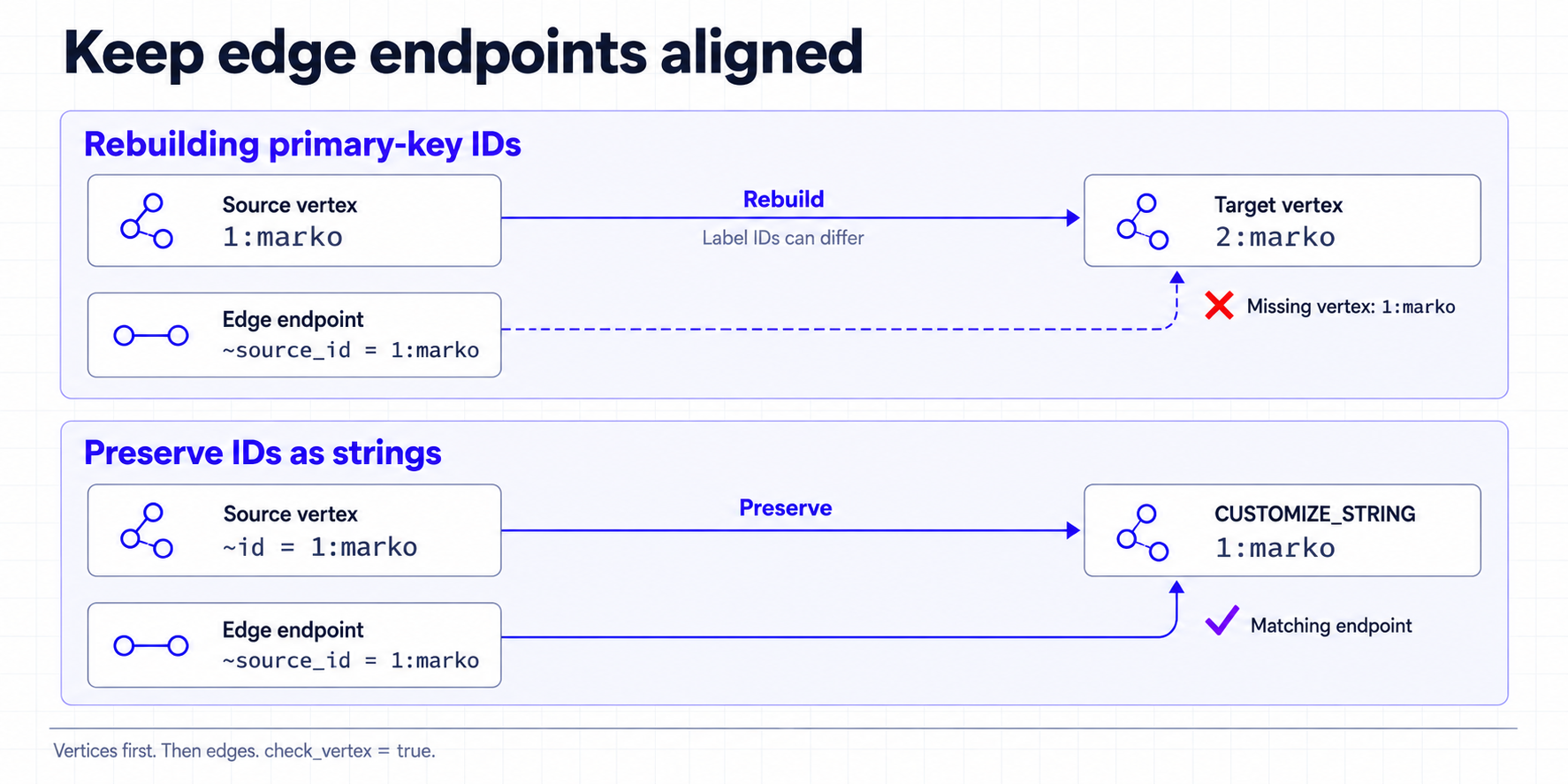
The following example migrates `person` vertices and `knows` edges from a source graph. Use a separate target graph. This section uses `CUSTOMIZE_STRING` to preserve vertex IDs. Do not reuse the `person` label created earlier with `PRIMARY_KEY`.
These two jobs migrate only the selected labels and properties. They do not copy every source schema setting, such as indexes and TTLs. Pause writes to the source graph during the migration so both jobs read a consistent point in time. Afterward, compare vertex and edge counts and sample properties.
[](/docs/images/seatunnel/seatunnel-preserve-ids-en.png)
### 1.1 Migrate vertices first
Source adds a `~id` column for the original ID, and Sink stores it as a string. Do not declare `~id` in `schema.fields`; manually declaring this reserved column is rejected.
> [!DETAILS]- Expand the configuration and save it as config/graph2graph-person.conf
> ```hocon
> env {
> job.mode = "BATCH"
> }
>
> source {
> HugeGraph {
> host = "source-hugegraph"
> port = 8080
> graph_name = "hugegraph"
> graph_space = "DEFAULT"
> label = "person"
> label_type = "VERTEX"
> schema = {
> fields = {
> name = "string"
> age = "int"
> }
> }
> }
> }
>
> sink {
> HugeGraph {
> host = "target-hugegraph"
> port = 8080
> graph_name = "hugegraph"
> graph_space = "DEFAULT"
> batch_failure_fallback = false
> mappings = [
> {
> type = "VERTEX"
> label = "person"
> idStrategy = "CUSTOMIZE_STRING"
> idFields = ["~id"]
> properties = ["name", "age"]
> }
> ]
> }
> }
> ```
```bash
./bin/seatunnel.sh --config ./config/graph2graph-person.conf -m local
```
### 1.2 Migrate edges second
After the vertex job succeeds, use the `~source_id` and `~target_id` columns added by Source to locate endpoints. Because the previous job preserved the original IDs, these columns can refer directly to vertices in the target graph.
> [!DETAILS]- Expand the configuration and save it as config/graph2graph-knows.conf
> ```hocon
> env {
> job.mode = "BATCH"
> }
>
> source {
> HugeGraph {
> host = "source-hugegraph"
> port = 8080
> graph_name = "hugegraph"
> graph_space = "DEFAULT"
> label = "knows"
> label_type = "EDGE"
> schema = {
> fields = {
> since = "int"
> }
> }
> }
> }
>
> sink {
> HugeGraph {
> host = "target-hugegraph"
> port = 8080
> graph_name = "hugegraph"
> graph_space = "DEFAULT"
> check_vertex = true
> batch_failure_fallback = false
> mappings = [
> {
> type = "EDGE"
> label = "knows"
> sourceConfig = {
> label = "person"
> idFields = ["~source_id"]
> }
> targetConfig = {
> label = "person"
> idFields = ["~target_id"]
> }
> properties = ["since"]
> }
> ]
> }
> }
> ```
```bash
./bin/seatunnel.sh --config ./config/graph2graph-knows.conf -m local
```
This example checks endpoints and makes write errors fail the job. The default `check_vertex = false` does not guarantee a consistent result: a missing endpoint can create a dangling edge, so a successful job is not a substitute for checking the migrated graph.
> **Why preserve IDs?** A HugeGraph `PRIMARY_KEY` ID contains the internal ID of the vertex label, and that internal ID can differ between graphs. For example, a source vertex can be `1:marko`, while regenerating the primary key in the target graph can produce `2:marko`. Reusing the source edge endpoints after regenerating vertex IDs can connect edges to the wrong vertices. This example stores the original ID as a string, which changes the target graph's ID strategy
When Source reads every label, omit `label` to read all labels of `label_type` (default `VERTEX`). It produces one output table per label. Bind each Sink mapping to its table with `sourceTable`, for example `sourceTable = "default.person"`; use the full table name shown in the Writer log for the exact value. Do not reuse the single-label configuration from this section. See the [HugeGraph Source documentation](https://github.com/apache/seatunnel/blob/3.0.0-release/docs/en/connectors/source/HugeGraph.md) for other limitations.
## 2 Export to another system (graph2any)
`graph2any` uses HugeGraph Source[1] to read vertices or edges and sends them to a downstream Sink. The example below exports `person` vertices to local JSON files; to export to JDBC, Kafka, or another system, replace `LocalFile`[2] and its options.
```hocon
env {
job.mode = "BATCH"
}
source {
HugeGraph {
host = "hugegraph"
port = 8080
graph_name = "hugegraph"
graph_space = "DEFAULT"
label = "person"
label_type = "VERTEX"
schema = {
fields = {
name = "string"
age = "int"
}
}
}
}
sink {
LocalFile {
path = "/tmp/hugegraph-export/${table_name}"
file_format_type = "json"
}
}
```
Save this as `config/graph2file-person.conf` and run it from the SeaTunnel installation directory:
```bash
./bin/seatunnel.sh --config ./config/graph2file-person.conf -m local
```
To export edges, change the Source `label` to an edge label, set `label_type = "EDGE"`, and declare the edge properties in `schema.fields`. Source also outputs the reserved columns `~source_id`, `~source_label`, `~target_id`, and `~target_label`; write them to the file or pass them to downstream transforms as needed.
This page covers row reads and writes. It does not copy source indexes, TTLs, or other schema settings. For the complete Source options and shared environment guidance, return to the [SeaTunnel graph import guide](/docs/quickstart/toolchain/import/hugegraph-seatunnel-connector/)[3].
## 3 References
**Connectors**
[1] HugeGraph Source
[2] LocalFile Sink
**Related guide**
[3] SeaTunnel graph import guide